
compassion2.com

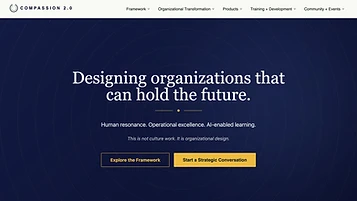

Organizational design · Neurobiology · Human flourishing · AI · Economic value creation
Carson D. Kelly is an entrepreneur, organizational strategist, author, and founder of Compassion 2.0. His work explores how organizations can intentionally create the conditions for human flourishing—and how those conditions translate into measurable organizational and economic value.

The thesis
Across more than 25 years in technology, enterprise software, and organizational work, Carson's attention has moved from the technologies and processes through which organizations create value to the human conditions from which value emerges. The work is organized around a proposition that increasingly defines it: human flourishing and organizational performance are not competing objectives. Properly understood, they are dimensions of the same system.
The institutional body of work
An institutional platform bringing together organizational design, neuroscience, leadership, technology, measurement, and human development to investigate how organizations can intentionally cultivate the conditions that allow people and systems to flourish. Includes the developing ORGLAB initiative.
Learn moreThe advisory vehicle
A consulting and advisory practice translating the ideas of Compassion 2.0 into the concrete decisions of leadership, structure, and strategy for founders, executives, and boards.
Visit Karuna VenturesThe philosophical foundation
A field of inquiry exploring how assumptions about reality, relationship, and value shape the systems we build. Generative Ontology provides the philosophical grounding beneath Compassion 2.0 and its practical expressions in organizational design and human flourishing.
Explore Generative OntologyA working thesis
“AI commoditizes process. Flourishing differentiates value.”
As intelligent systems take on more of the procedural, analytical, and operational work once performed by people, organizations will need to reconsider where distinctly human value originates. This is Carson's emerging thesis—still in development, and increasingly consequential.
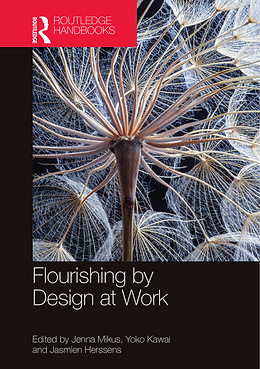
Cover mock-up
Forthcoming
Routledge (Taylor & Francis) · Q1 2027 · Contributing author
A peer-reviewed academic volume edited by Jenna Mikus, Yoko Kawai, and Jasmien Herssens and published by Routledge, an imprint of the Taylor & Francis Group. Carson's chapter, Organizational Flourishing and the Neurobiology of Organizational Design, co-authored with Michael Pirson, Ph.D., introduces the Organizational Flourishing Construct and examines how trust, psychological safety, relational resonance, and institutional design shape the capacity of individuals and organizations to flourish.
Read more about the bookIdeas
01
Flourishing is not a benefit provided to employees. It is an organizational capacity. Rather than treating compassion, psychological safety, trust, belonging, or well-being as peripheral cultural initiatives, this work examines how these relational and physiological conditions affect an organization's ability to learn, adapt, innovate, collaborate, decide, solve problems, and create value.
02
Organizations are not only structures of roles, processes, incentives, and technologies. They are environments continually influencing human nervous systems. Leadership behavior, structures, incentives, technologies, relationships, and everyday interactions shape the physiological and psychological conditions that affect how people perceive, think, relate, create, and act. The design of an organization influences the human capacities available to it.
03
A central focus is moving flourishing from aspiration into measurement. The ROI of Care is a framework in development for understanding the relationship between investments in human and relational capacity—trust, psychological safety, relational capacity, repair, collaboration, adaptability, creativity, execution—and measurable organizational performance. The question becomes not only what does care cost, but what capacity becomes available when people can function at their best.
04
This is a working thesis. As intelligent systems take on more of the procedural, analytical, and operational work once performed by people, organizations will need to reconsider where distinctly human value originates. As process becomes abundant and inexpensive, judgment, creativity, empathy, wisdom, trust, meaning-making, imagination, and relational intelligence may become increasingly important sources of differentiated value.
05
Carson describes the emerging economic and organizational transition as the Flourishing Age: a period in which the ability to cultivate and activate human potential becomes an increasingly important organizational capability. From this perspective, flourishing is neither a wellness initiative nor only an ethical aspiration—it becomes a question of organizational architecture, human capability, and value creation.
06
Ideas about flourishing become useful when they inform how organizations actually work. ORGLAB, a developing Compassion 2.0 initiative, is intended to bring organizations, researchers, and practitioners together to design interventions, measure outcomes, and compare approaches. The aim is to learn which conditions expand human capacity and how those conditions can be sustained in everyday organizational life.
Platforms in practice
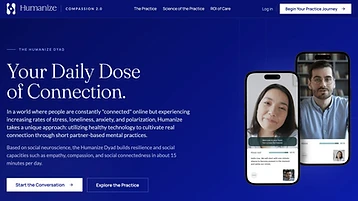
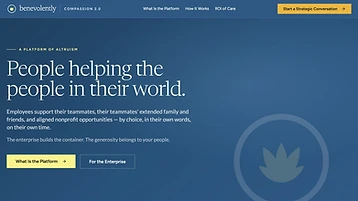
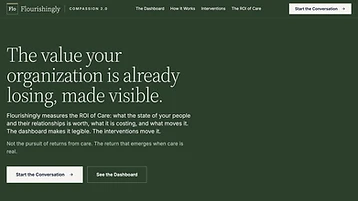
These platforms are practical expressions of Compassion 2.0, which rests on a philosophical inquiry into how assumptions about reality, relationship, and value shape organizations—explored as Generative Ontology.


